
Why Broadway?
From bags to protective wrap, we’ve got you covered.
Broadway Industries is your partner for high quality, innovative solutions and expertise in product and goods protection for moving, storage, retail or during transit.
Learn MoreNeed help selecting the right paper bag?
by | Posted in: Uncategorized

Bans on single-use plastic bags – one of the most widespread sources of global pollution – are in effect in cities and states across the nation, with New Jersey being the latest to roll out a ban designed to combat plastic pollution.
According to the United Nations Environment Program (UNEP), plastic bags became widely adopted in the late seventies due to their durability, water-resistance, and functionality. When Safeway and Kroger introduced plastic bags in 1982, they soon became the norm in supermarkets and convenience stores across the country.
What was once a novelty became widely adopted, and plastic bags soon found their way into both the home of almost every American and the ocean’s deepest depths. The Environmental Protection Agency now estimates that 380 billion plastic bags and wraps are used every year in the United States, requiring 12 million barrels of oil to manufacture. Polyethylene, the type of plastic used to produce most plastic bags, is derived from either crude oil or natural gas. Because polyethylene is not biodegradable, plastic bags end up in landfills, in oceans, and as litter. According to the EPA plastic pollution, which is mostly made up of grocery bags, costs some communities in the U.S. $1 million in annually in clean up and removal.
Countries began banning plastic bags in response to growing global calls to reduce waste, with Bangladesh taking the lead in 2002. Since then, more than two dozen countries have moved to reduce the use of plastic bags. However, in the U.S. no single unifying law specifies consistent restrictions on plastic bags. Instead, states, territories, and municipalities have passed their own local legislation to combat the impact plastic bags can have on the environment. Unfortunately, this has caused significant confusion for retailers and consumers.
Navigating evolving bag ban regulations is a challenge for many businesses. For example, if a retailer has multiple locations in different counties, cities, or towns within the same state, ensuring each location adheres to the local bans, fees, taxes, or ordinances is a difficult task.
As state-wide bans against plastic bags roll out across the U.S., many businesses are confused about the national effort to curb plastic pollution. Laws to ban single-use plastic bags are in effect in Puerto Rico plus ten states – California, Connecticut, Delaware, Hawaii, Maine, New Jersey, New York, Oregon, Vermont, and Washington. In addition, some cities have imposed restrictions without adopting state-led legislation.
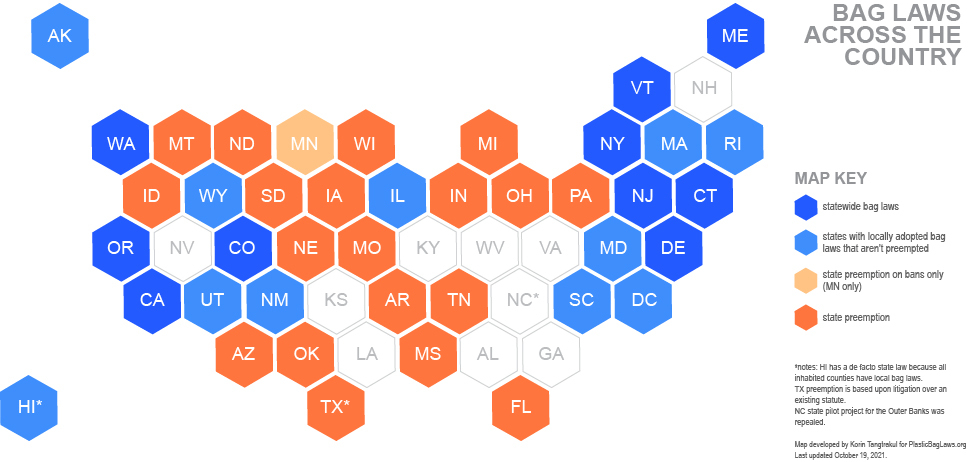
Bag Laws Across the United States
Legislators have introduced at least 95 bills related to plastic bags in 2019. Many of these bills prohibit the use of, or place a fee on, single-use plastic bags, while others strive to improve existing bag recycling programs. Some bills are designed to prevent local government action that could conflict with state level regulations.
Map source: State Plastic Bag Legislation (ncsl.org)
Preemption Map of the United States
To add further confusion, state legislators in Arizona, Arkansas, Florida, Idaho, Indiana, Iowa, Michigan, Mississippi, Missouri, Montana, Nebraska, North Dakota, Ohio, Oklahoma, South Dakota, Tennessee, Texas, and Wisconsin have already preempted plastic regulation on a variety of packaging items including plastic bags. In addition, preemption laws prohibit municipalities from adopting local ordinances that further regulate a particular product, namely preventing bans or fees on carryout plastic bags.
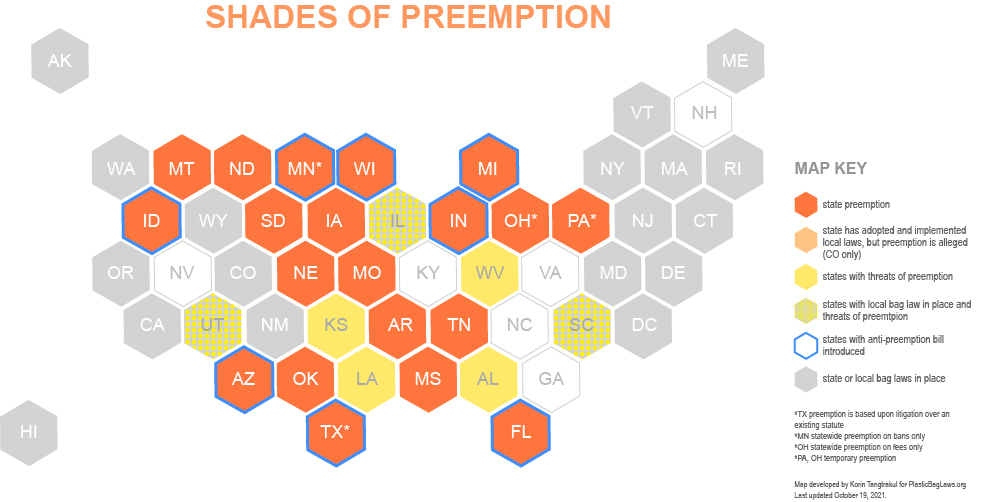
Sourced from https://www.plasticbaglaws.org/preemption
Starting May 4, 2022, the strictest plastic bag ban in the nation will go into effect in New Jersey.
On this date, all stores, including food service businesses and grocery stores, are prohibited from selling or providing customers with single-use plastic carryout bags. Paper bags are allowed, except by larger grocery stores. Grocery stores that occupy at least 2,500 square feet may not provide single-use paper carryout bags. Reusable carryout bags provided by or sold by businesses must meet specific requirements and customers are allowed to use their own personal bags.
The NJ bag ban law states that a person or entity that violates the law will be warned for a first offense, fined up to $1,000 per day for the second offense, and fined up to $5,000 per day for the third subsequent violation. Violations of a continuing nature constitute an additional, separate, and distinct offense for each day of that violation.
In 2019 New York became the second state, after California, to pass a ban on single-use bags in an effort to cut back on plastic waste and remove approximately 23 billion single-use plastic bags (per year) from stores across New York.
Each state’s ban is specific to their needs and contains differences in everything from how “reusable bag” is defined, whether fees can be charged for distribution of single-use bags, and how the regulations are enforced.
Broadway has created a guide to help identify locally compliant products that protect both businesses and the environment.
Download our 2022 Bag Ban Guide to learn:
Tell us what you’re looking for and an expert will follow up to determine how Broadway can meet your needs.
From bags to protective wrap, we’ve got you covered.
Broadway Industries is your partner for high quality, innovative solutions and expertise in product and goods protection for moving, storage, retail or during transit.
Learn More